PETERSFIELD’S TOWN HALL
A MUNICIPAL CENTRE
Lord Mottistone Opens
DR. H. ROBERTS’S DREAM REALIZED
Praise and Cheers
MUCH SUPPORT FROM OUTSIDE THE TOWN
A modest and retiring personality in the public life of Petersfield has been working behind the scenes during the last three years for the realization of a dream of his—the erection of a Town Hall as the town’s municipal centre.
He is Dr. Harry Roberts, and when the venture got going he became the Secretary of the Town Hall Committee. At the opening ceremony on Monday of the now complete centre, at which Major-General the Right Hon. Lord Mottistone, Lord-Lieutenant of Hampshire, officiated, congratulations and praise were heaped upon Dr. Roberts by almost every speaker without exception. Lord Mottistone called for there cheers for the doctor.
Mr. Alan Lubbock, C.C., was in the chair as Chairman of the Town Hall Committee. ‟After two and a half years or more waiting, hoping, wondering, and perhaps doubting, we are here at last to celebrate, simply but solemnly, the opening of this noble Hall,” he began. He hoped that that day would mark an epoch in the history of their beloved town and countryside.
Launched on Career of Usefulness
It is in this hope—that the hall would serve a really valuable purpose in the life of the community—that they were drawn together. He mentioned the various purposes for which the hall might be used, occasions for artistic efforts and for social intercourse. The surroundings were beautiful and they were all thankful that that day had at last dawned.
They were grateful to Lord Mottistone for coming there to launch their hall on its career of usefulness. Next to serving his country, Lord Mottistone, as a Hampshire man through and through, loved to serve his country. Opened by Lord Mottistone this hall would start its life under the happiest of auspices.
A Recapitulation
The speaker said he would recapitulate the events which had led up to that day. He spoke of the devoted efforts of individuals and the incredibly hard work which had made that issues possible. As long ago as he could remember a frequent subject of conversation in Petersfield was the regret that so many deserving enterprises seemed to founder for the want of a decent well equipped public hall.
Then, two and a half to three years ago, several people decided to face this question. If there was a demand for this hall then surely there must be a way of satisfying it, they thought. A gathering body of support was aroused not only in Petersfield but in the districts to.
A Committee was formed representing the ratepayers, the educational, the artistic and the intellectual sides of the town’s life. They met to decide what were the requirements of the thing that they had all been speaking about for so long. How, where and why and what sort of hall was wanted? What was the least sum of money which could be worthily spent on it? They set to work on a difficult problem.
The Petersfield Urban District Council were approached with a view to finding out their attitude. ‟Then the Urban District Council made a decision which I am convinced was a historic one, seen from the point of view of the generations to come. It was no less than that they would co-operate to this extent, that under one roof and building there should be both municipal offices and the public hall.”
Subscriptions came in
The Urban District Council lifted the whole problem on to a different plane. Success was in sight. The ideal of the hall was that on a Monday it could be the scene of a theatrical show, on Tuesday a dance, on Wednesday a political demonstration, and on Thursday an art gallery and so on. Subscriptions began to come in. Mr. Mackarness held out his ever open hand. Now where did the subscriptions come from, Mr. Lubbock asked? Petersfield was a little country town like hundreds of others in other parts of England. The citizens subscribed nobly, as did the people from surrounding districts. But there was an enormous body of support from people living in different parts of the country, miles away from Petersfield.
It was wonderful to think, Mr. Lubbock continued of the wide interest and deep feeling for such a small country town as Petersfield. The famous Musical Festival took pride of place among the institutions which had spread this interest. They had much wanted Dr. Adrian Boult to be with them on that occasion, but they had received a telegram excusing him from attending on the grounds of other duties.
Lord Mottistone
Lord Mottistone was called upon to open the hall, and in his initial remarks he said he rejoiced with them, and congratulated them on their labours, which had at last reached fruition. The new hall befitted Petersfield as the centre of a large part in Hampshire. He was told that that was not a good day to open a hall, as it was the day of the annual fair. Well, he remembered, he said, buying a horse at the fair when he was just a boy. He found he could not pay for it, and his grandfather had to help him out of his difficulty. He left Petersfield without any great stain being made on his youthful character.
Music and the Love of Horses
Lord Mottistone referred to the annual Fair that was taking place that day at Petersfield and to the Musical Festival for which the town was well known. It was good that music and the love of horses could go together, he said. They had the space in the country for the horses, and the space in the Town Hall for the Festival.
His sone, the Hon. John Seely, was one of the architects who designed the building, he reminded the large audience of 600. It was not the first building they had done—there were others in various parts of England and Scotland, but he was glad his son had erected something in Hampshire, the county that he loved so much.
He offered £10 unconditionally to the Town Hall fund, and if another 15 persons could be found to do the same he would then give another £10. The Lord Lieutenant went on to speak of how the buildings which housed people affected then and altered their lives.
The Hal, said Lord Mottistone, would make a great difference to the people working in it; new premises, a proper buildin, made all the difference. There was a difference felt, too, in the minds, the happiness and feelings of the people who lived in the town where the new building was erected.
Somnolent Councillors
If you house your Council in a building with bad ventilation the Councillors fall asleep. Only the bores go on talking. Then those that have fallen asleep wake up in a quarrelsome mood, and even the best chairman in the world (‟as I am sure you are,” said Lord Mottistone to Mr. G. Bailey) cannot get good work done.
He had noticed the great difference in Southampton since the town had a civic centre worthy of the name. ‟You cannot get good work from people who are not properly housed,” he said. He had met instances time and time again during his 17 years’ experience touring the country.
The best Sid of the English character was evidenced by the combination between civic effort and private generosity. ‟In the King’s name I declare this building open for the benefit of the inhabitants of Petersfield,” he concluded.
The Hall ‟A Big Baby”
Dr. Harry Roberts, in a short but exceedingly witty address, said he was an embarrassed speaker. Professionally, as a doctor, he had attended many births, but never with so many people looking on! The hall was certainly a big baby, he remarked.
He had been pestering them for the past two and a half years with circulars, appeals, and begging letters, until he imagined they had almost come to dread the sound of the door knocker. They had been hampered by a shortage of money, but had got their money’s worth in the end. The Hal, he hoped, would be used to increase human equality and social fellowship. It was the local temple of amusement, knowledge, and beauty.
There was not many people who, when they began this work, ever imagined that they would see at this stage, he continued. He mentioned several persons individually who had helped tremendously in the work. Mr. F. Carpenter was thanked for his assistance given in publicity. The contractors had had a difficult task. No-one could estimate how much money they actually had to spend, and working to an unknown limit was very difficult. It was not the same as if they had had £10,000 to spare.
Another £10 Offered
Dr. Roberts said he offered also to give £10 towards the fund, and that made only 14 others to get before Lord Mottistone lost his offered £10. The chief thing was the use to which the Town Hall was put. People should go on taking pride in it. Much more had to be done yet, and further interest was needed.
Gift to Council Chairman
Mr. G. Bailey (Chairman of the U.D.C.), was presented on behalf of the Town Hall Committee, with an ambroidered table runner with the Petersfield arms worked in coloured materials. The present was made by Miss L. Pleasant from the Petersfield County High School for Girls.
Mr. Bailey, in returning thanks, said he hoped the school would flourish in the future as it had done in the past. Mr. Bailey went on to say that a date was put to Lord Mottistone as a favourable one for the opening of the Hall but his Lordship replied that that day was the only one he could give them. They were so anxious to get him to Petersfield that the fear that the opening might clash with Fair Fay was put aside. They were glad that this fears were found to be unjustified. Petersfield was on the borderline of the county, and he had heard it said that they were sometimes overlooked and forgotten. But they were assured by the presence of the Lord Lieutenant that that was not so. The hope was expressed by Mr. Bailey that the town would increase in popularity. He referred to ‟their dear old friend Dr. Roberts.” But for him he doubted if the town hall would have been built at all. He (Mr. Bailey) proposed a vote of thanks to Lord Mottistone.
Mr. A. J. C. Mackarness (Treasurer of the Town Hall Committee), in seconding, also spoke of the hardworking secretary. ‟Dr. Roberts’s inexhaustible energy, resourcefulness and continuous sense of humour have helped us through the difficult times,” he stated.
There were three things they must never forget in Petersfield. The amount of support which had been given by outsiders was one. Petersfield people had helped most generously, but a very large sum had been gained from those out of the town. The second thing to remember was that lovers of music had subscribed a large sum, no less than £2,000. That was a big item. It was good to think that the Musical Festival should draw such support. The third thing to remember was Dr. Roberts and his tremendous help. Dr. Roberts’s family had also done wonders. Mr. Mackarness concluded by thanking everyone for their great generosity. His own task as Treasurer had been a pleasant job indeed, though he thought at a the beginning that it was not going to be so.
Lord Mottistone in replying to the vote of thanks, said he was going to test the Town Hall and see if it would stand the strain of three hearty cheers.
These were given.
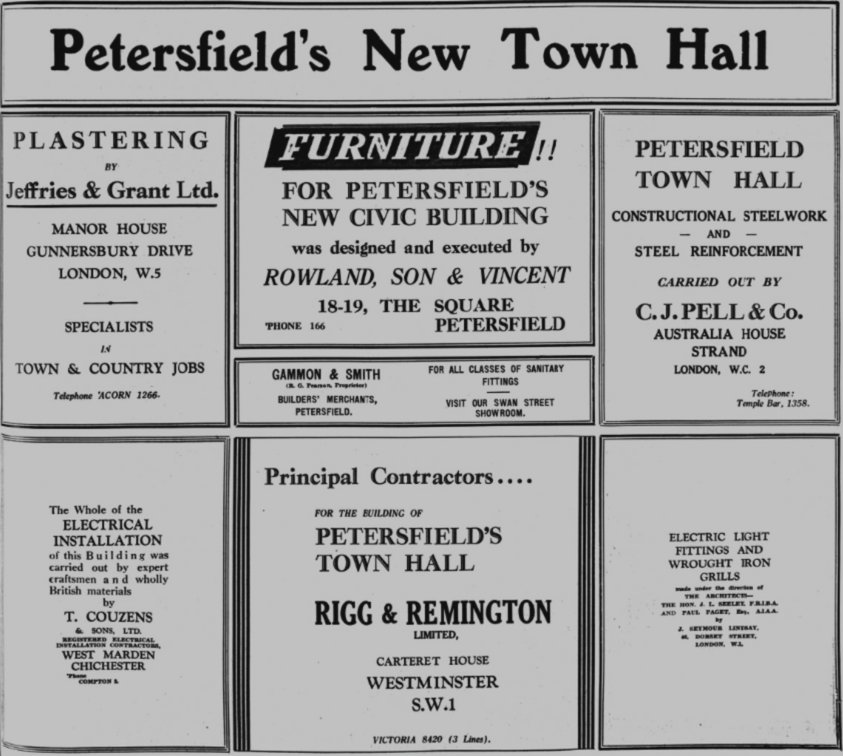
THE FIRMS BEHIND THE NEW TOWN HALL
The principal contractors for the new Municipal Offices were Rigg and Remington, Ltd., of Carteret House, Carteret Street, Westminster. The success with which they have carried through the work, in spite of the handicaps met with, was referred to during the speeches of the opening day.
T. Couzens and SonsLts., of West Marden, Chichester, were responsible for the whole of the electrical installation. British materials were wholly used—is there a better recommendation? A specially constructed ironclad switch-board controls the whole system.
Messrs. Gammon and Smith and Messrs. Rowland Son and Vincent, both of Petersfield, played important parts in the new building’s erection. As local firms they take pride in both the hall itself and in the fine craftsmanship that they have put into its construction. The former dealt with all the sanitary fittings and equipment. The results speak for themselves. The latter firm designed and executed the furniture, which is noteworthy for its appropriate colourings, its comfort and its serviceable qualities.
Specialists in their branch of work, Messrs. Jeffries and Grant, Lt., of Gunnersby Drive, London, W.5, did their share, too, in perfecting the civic centre. Plastering in all its intricate and difficult phases, has been for the study of this enterprising firm for years.
The Town Hall has a reliable and solid structure, thanks to Messrs. C. J. Pell and Co., of Australia House, the Strand, who, with reinforced concrete and all manner of steel work, built up the ‟skeleton” upon which most of the other contractors had to work. Pell’s work stands the test of time.
Under the direction of the hall’s architects, J. Seymour Lindsay, of Dorset Street, London, supplied the electrical fittings, electric lighting and wrought iron grills. Essential, vital, and in some cases decorative at the same time, the various electrical attachments have proved their worth and utility already.